

Alfred Newman: 20th Century Fox Fanfare & Street Scene (1931)

0:00 - 08:44 mins
It was so weird hearing the Fox Fanfare live. Everyone knows this piece, wherever you are, if you hear that fanfare you feel yourself thinking, where's the popcorn?, like if you're about to enjoy a cinematic experience. It sets you on autopilot. Those military-like drums, followed by the booming brass, and distinctive strings, really wake you up and alert you to keep watching - you're about to witness something great.
As for Street Scene, I have never seen the film itself, however I have seen How To Marry a Millionaire numerous times (where it was re-used). Wilson's use of it to open the concert was interesting. It's a very dramatic piece and has a wonderful buzz to it - mirroring the idea of bustling streets and busy city life. It opens our musical senses and starts them turning readily for the rest of the show. It was the ideal appetiser.
Bronislau Kaper: Forever, Darling (1956) - Confetti
08:44 - 11:27mins
Light and lively, this piece lifted the spirits and conjured images of romantic comedies from the golden era. A serene and jolly calm before the concert took a dive into darker tunes from murkier movies...
David Raskin: Laura (1944) - Suite
11:27 - 17:47 mins
 I adore the film Laura; the plot isn't just captivating from start to finish but dotted with exquisite moments of humour, crime, and romance. Everyone remembers the villain, the detective, and Laura herself, but possibly the most memorable element of Laura was the title theme.
Wilson begins conducting the piece with a grimace on his face, and rightly so. The opening bars of the Laura suite are unnerving and haunting - ominous low notes play, reminding us that we are in the dark world of film noir and that there is murder afoot. Then the unmistakeable Laura theme is introduced quietly, a beautiful lady plucked from the dark depths of noir as if by magic. For anyone who has seen the film, we immediately see the painting of Laura, looking ever-so dreamy, and our detective falling slowly in love with her image and memory - as told to him by suspects.
Every man who encounters Laura falls in love with her. For the film they had Gene Tierney play the title role, which made it easily believable that all who met her would fall for her - she was ridiculously beautiful after all. But the film needed more than that. It needed music to enhance her beauty by creating added wonder, tragedy, romance, and the idea of obsession. Hearing the music without watching the film, you could hear the music as it was meant to be heard - it was the sound of Laura's spell which bewitched every man who knew her, with the unmistakable notes of doom lurking beneath that romantic sweep.
Bernard Herrman: Psycho (1960) - Suite for Strings
17:47 - 24:55 mins
 The most recognised film score of all time? Possibly. Even if you haven't seen the film Psycho, odds are you've heard the theme. I had seen old Proms performances of Psycho online, but that didn't ruin the experience for me at all. Hearing the music live is very different and seeing the effect on people in the audience is unique. What I really remember from my seat so high-up in that hall was all of these violin bows moving frantically and briskly - as if in a frenzy. But of course that is the genius of Herrman the composer.
His music had to physically resemble the psychotic mind of our killer and frenzy of the killings themselves. Additionally, the piercing notes we hear from the strings are painful and make us uncomfortable, which is how we should feel. This isn't a pleasant tale and the film itself is disturbing. What is wonderful is that Herrman composed a suite that enhanced the films impact, and immeasurably so.
The opening title sequence is quite dizzying and there is this feeling of a chase, that we are running from something (like Janet Leigh in her car), but soon we come to a quick demise and the notes become slower and lower. This is the calm before the storm, because shortly afterm we hear the infamous theme for the shower scene. Watching it performed live, you see the violence of the piece. Even without watching the murder, the musicians themselves look as if they are murdering their instruments. Bows slashing down hard ferociously at the strings - the piece is very violent and a mirror image of the action of the killing. The entire audience would have felt unnerved at some point during this suite, and I'd bet money that most had hairs standing up at the back of their necks.
Citizen Kane (1941) - Salammbo's Aria
24:55 - 29:40 mins
I was slightly disappointed when I saw which part from the Citizen Kane soundtrack was being performed. I was hoping for 'Snow Picture,' but I had no need to be disappointed. This stunning aria escaped my notice with my viewings of Kane, and I have no idea why! It is a show-stopper! Super dramatic with its big notes echoing through the hall, all sung sublimely by soprano, Venera Gimadieva... it was a beautiful and wonderful piece. I've never seen an opera singer live before but it's quite an experience hearing such a strong voice fill the concert hall.
Erich Wolfgang Korngold: The Adventures of Robin Hood (1938) - Suite
29:40 - 46:50 mins
 One of the first classic films I ever watched and definitely one of my favourites, I was always going to be biased when it came to this performance. The soundtrack from The Adventures of Robin Hood is one of the greatest and I feel so honoured and lucky to have had the privilege of hearing the suite performed live in all its splendour. The opening bars are full of life, colour, and the excitement of the film. You can instantly see Errol Flynn swinging around Sherwood forest, laughing in the face of danger, and surrounded by his Merry Men. But even more so, you hear the unmistakable sound of the Golden Era, Hollywood at her biggest and best. This soundtrack has everything and changed everything when it came to sound in film. Such an incredible blend of medieval sounds with that indisputably Hollywood sweeping of strings - this suite is to die for. I was over the moon when I saw that it was going to be performed, and thankfully, John Wilson and his orchestra exceeded all expectations.
34 mins - The love theme from The Adventures of Robin Hood begins. This is my favourite piece of film music, no competition whatsoever. No other piece is as romantic, magical, dreamy, or majestic. The opening bars seem to flutter higher and higher (just as we are going high up into the castle, into Maid Marian's chamber where Robin Hood will soon appear). A trumpet plays a few romantic notes but because it's a trumpet, it also represents the sound of good and justice (that which Robin and Marian are fighting for - it has already been noted in many studies how Korngold kept the idea of justice in every scene, even the romantic ones). And it goes on, with the whole orchestra sweeping round and round and up and up in this beautiful romance - as if we're walking on air like Maid Marian.
 38 mins - Now the piece goes up another level. My favourite part of the whole love theme - where things get serious between Robin and Marian. They declare their love for each other and vow to fight for the good of England, no matter what danger they are in. The cello (?) at 38:10 mins reflects the seriousness of their peril. Marian is in danger in the castle, and Robin doesn't want to leave her there because he loves her, but he knows that she must stay for the good of the land. It is a very tender, serious moment between the pair, and the cello is the perfect sound for that. At 38:45 mins we have the sax popping in again - super smooth and soothing - reminding us that this is a romantic meeting and not a political one.
From there on, the music just gets fuller and bigger. The orchestra is on full power mode, and mirrors Robin sweeping Marian off her feet. Even Wilson's gestures look as if he is preparing for the final hurdle - the big finale of the piece. This is where Korngold outdoes himself. At 39:10 mins we are shown Wilson again, and his movements... he looks like a magician casting some sort of intricate, delicate spell - how much more beautiful can this music get? His movements are magic, and the camera zooms in to show him closer at 39:19 mins... He is completely caught-up in the music, and his gestures show the intense emotion of the piece. On the night I wasn't able to see Wilson closely, but watching the concert on television a week later was wonderful to see because it showed how into the piece he was, how even he, after god knows how many times of conducting it, was still affected by it.
The piece has reached its finale, and our orchestra/conductor go into overdrive. Never mind the Olympics, the next few minutes look like the world's hardest workout. The precision, effort, and strength needed to perform this flawlessly is unimaginable (the commentary on the televised version said how the musicians stated that this was the hardest piece they had to perform). The talent of these people and their focus/power is incredible, and seeing it all on stage in those moments performing the most genius and beautiful of musical works, was astounding. The final 30 seconds are quieter and softer - Robin is bidding Marian goodbye. Again this is a very tender, intimate moment, because they know that they are both in danger, and they don't want to leave each other, but they must. As Robin climbs down the vines in the dark of the night, Marian watches lovingly and proudly at our hero and her love... just the fact the Korngold knew to tone things down for that goodbye shows how gifted he was.
 Of course, that is the end of the love theme but not the suite itself. We follow with the battle scene and the victory - all big, brash, and full of Hollywood vibrancy. But for me nothing comes close to the love theme. Words fail to describe it and do it justice. Hearing and watching Wilson and his orchestra is what you need to do to fully understand it's beauty, power, and Hollywood quality. Even someone who hated classical music and never wanted to even think of giving it a chance would be blown away by this part of the performance. It is one of those pieces that touches the heart and transcends the soul. I was moved to tears, not because of the fact it was my favourite piece, or because I loved the film, or even because it conjured images of Flynn and deHavilland in their prime. I was brought to tears because this orchestra had made that piece even more enchanting than I could ever have imagined. It was all rather overwhelming.
*INTERVAL 20 MINUTES*
Jerome Moss: The Big Country (1958) - Main Title
52:33 - 56:23 mins
Those strings are absolutely fantastic live in this piece. They fill the concert hall, illuminating in our minds the vision of great expanses of land far out in the Old West. Big, brassy, and loud, this was sensational. After a short interval, it threw us straight into the thick of things again.
Max Steiner: Casablanca (1942) - Suite
56:23 - 1:05:20 mins
 The suite for Casablanca is so clever with it's layers and multiple themes. Bursting open with fanfare and then descending into an exotic melody that is both adventurous and dangerous, hinting that we are in a warmer, foreign lands for this film. But the vibrant, tropical tune soon dissipates into the Marseillaise and then into Deutschland uber alles - thus telling us that this is the Second World War, and here it is a case of the Allies and the Nazis. Just from those opening bars Steiner tells his audience the location, the era, and the political situation - genius! These two national anthems are dotted throughout the score of Casablanca and really provide enormous depth to the soundtrack and enhance the feeling of patriotism in the film. But they are usually only snippets, so as not to cloud the plot with too much doom. So before long, we have the exotic, adventure theme back in play.
 Two minutes into the suite and we finally hear the distinctive melody of As Time Goes By, a song that is interwoven in the fabric of the entire Casablanca score. Light, romantic, and memorable, the tune provides the backdrop for our romantic and tragic story - that of Rick and Ilsa. What is remarkable is that the theme of As Times Goes By gets stronger, more powerful, and fuller as the film progresses. When we first hear it, it's like an old memory - the long lost love that our lovers left in Paris. This is shown via a piano solo - replicating Dooley Wilson's role as Sam. But as they rekindle their affair and the love they felt is shared again, the theme goes from strength to strength, until it is played out in full throttle, loud and proud, at the end of the film... here's looking at you kid. It is at its strongest when the lovers show the ultimate gesture of love.
Casablanca is the perfect film and it has the perfect soundtrack. What Steiner did is combine all the elements of the plot into a beautiful blend of a score, but always keeping the theme of As Time Goes By at the forefront of it all. Wilson and his orchestra performed this suite masterfully.
Movie Theme Song Medley
1:05:20 - 1:20:15 mins
The artists who performed the vocals for this medley were soprano, Jane Monheit, and vocalist, Matthew Ford, respectively. This was a real treat. A breather from the serious scores and suites we've had the pleasure of listening to for the past hour. An array of greats were sung and they were really brought to life. My favourite from this ensemble had to be the title song of Love Is a Many-Splendored Thing.
Franx Waxman: A Place In The Sun (1951) - Suite
1:20:15 - 1:28:53 mins
 If you want sensual romance, then look no further than A Place In The Sun. Again, one of my first films from the era, and very much a favourite, A Place In The Sun boasts the most beautiful couple in movie history and some of the most romantic moments preserved on film - all served with intense sensuality provided by a solo saxophone (here performed by the excellent, Howard McGill).
Like with most great romances, this one between George Eastman and Angela Vickers has a backdrop of tragedy. Waxman, as always, keeps the foreboding doom of George lurking beneath the score. Let's face it - the underlying theme of this film is unwanted pregnancy, dark waters, drowning, murder in mind, and accidental death... hardly romantic. Throughout the film George is anxious and in emotional turmoil - sometimes in the highest ecstasy as he dances with the lovely Angela, then plunging into the desperate depths of trying to shake-off his former life, and the girl he wants to leave behind. Not to mention later the guilt of his actions and the certainty of him being caught by the police and being lost to Angela forever.

Wilson and his orchestra's performance were nothing short of majestic here. It's as if every note that came from that saxophone brought with it clouded images of Clift and Taylor dancing, declaring their love, and spending the best part of their time saying goodbye. Such a stunning score and from a stunning film, Waxman creates an immortal theme for those immortalised images of Clift and Taylor on screen. This was definitely a highlight of the evening.
Scott Bradley: Tom and Jerry at MGM
1:28:53 - 1:36:33 mins
 Now this was a real surprise. When I saw Tom and Jerry in the programme my first thoughts were, that's a bit odd. Why has John Wilson chosen that? I seriously had my doubts. Like most kids I liked the cartoon, but I didn't think the theme was suitable for this concert. How wrong was I? From a general point of view, this was what people went home talking about at the end of the night.
 Where I was sat, very high up, I didn't actually see the percussion's performance until I saw the concert televised. But still, the sound was incredible, and hugely entertaining. I cannot imagine the amount of hours put into piecing this music together, nor the amount of rehearsal time. It was worth it though. The performance was spectacular and a thrill to see.
 The programme states, 'the cartoons are largely dialogue-free, yet Bradley's dazzling, wall-to-wall music passes almost unnoticed because it's so precisely expressive of the all-consuming action.' They've hit the nail on the head here because when you watch the cartoons you see the action, you don't notice the music. But when watching this performance you didn't have the action in front of you, all you had was the music, and yet every single performance by every instrument was so precise (kudos, Scott Bradley) that we could see the action in our heads. I could see Jerry being chased, Tom being the chaser, Jerry tip-toeing, Tom creeping, one of them banging into something and shaking from head to foot, one of them being knocked out and feeling dizzy, things flying through the air - all mixed in with a super-chilled, charming melody - this is the norm in the Tom and Jerry household! Jerry's moment sounded slightly softer, effortless, and sweet, whilst Tom's had a harsher, devilish ring to theirs. The percussion were armed with all sorts of strange instruments for this segment - multiple horns, and a dustbin where they would smash plates - replicating the chaos and destruction caused by Tom and Jerry's mischief. There are even a few screams thrown in there - nothing was left out!
My favourite sounds were those like at 1:30:44 (Wilson even shows a little grin when we first hear that sound). It's a funny sound anyway, and even though I can't place exactly where it appears in the cartoons, I imagined it would be where Tom encounters a trick left to him by Jerry, or vice versa. I could be wrong but that's why I'd laugh.
Wilson and the entire orchestra really looked like they had a blast with this one. The whole piece expresses the chase of Tom and Jerry and how they endeavoured on a perpetual battle of wits. You couldn't help but smile whilst you watched this, and laugh at all the hilarious sounds the musicians recreated. The whole theatre was smiling and cheering by the end, not just because of the fabulous show, but for the action-packed, remarkable nature of the performance. And not forgetting, the genius of Scott Bradley.
Miklos Rozsa: Ben-Hur (1959) - Suite
1:36:33- 1:44:00 mins
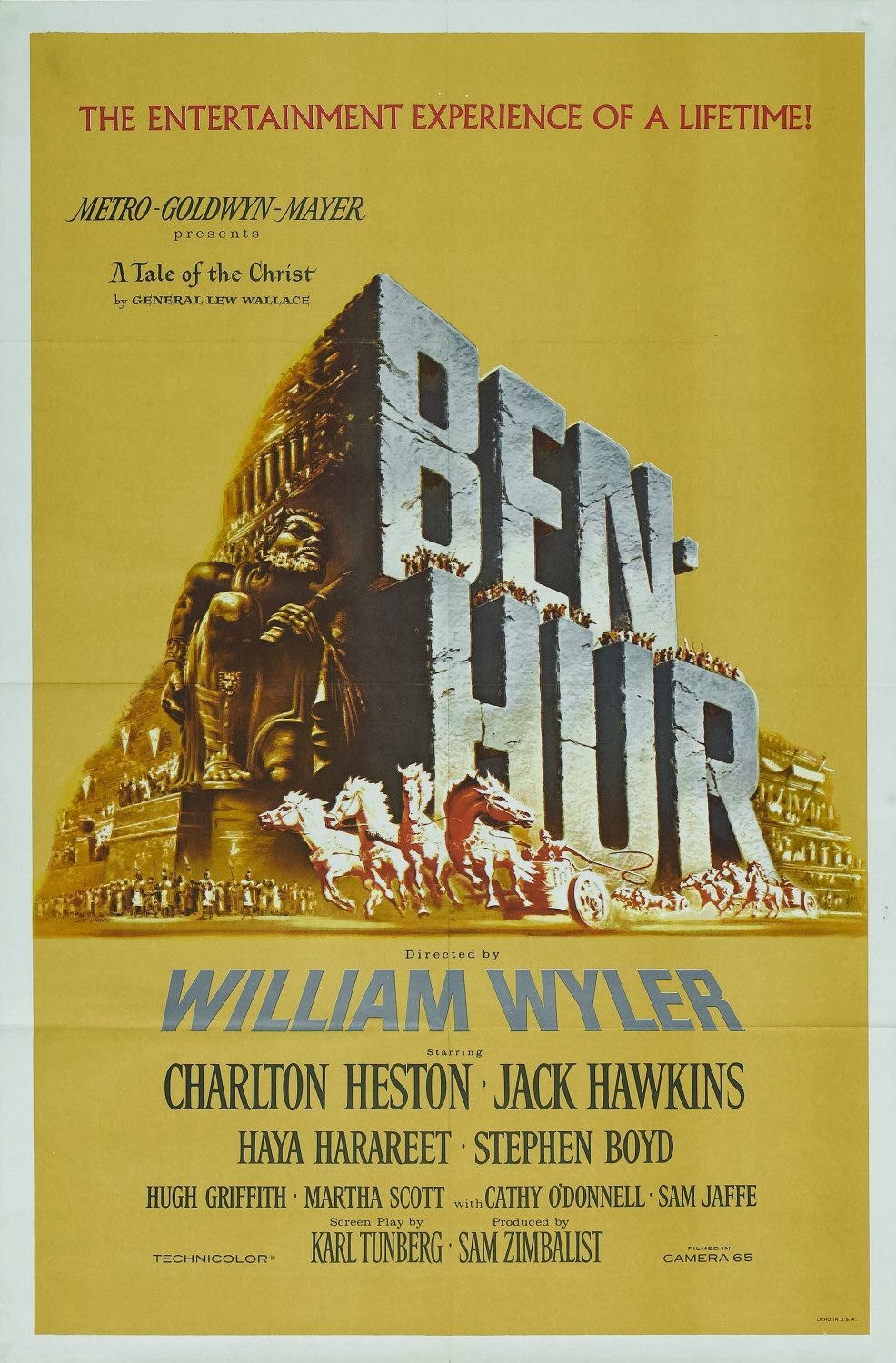 Now at the very beginning of the concert I noticed that behind the stage was an enormous organ. I don't know why but I'm always fascinated by organs - whether it's in a cathedral or theatre, they just always dominate the structure with their huge pipes and imposing size. The one in the Royal Albert Hall is a monster and I was thinking throughout the entire concert - I hope they play that! They saved the best for last, and probably with the best soundtrack to showcase the power of an organ. Ben-Hur is an epic film in every sense - it's story, it's length, and it's hero. You need one hell of a soundtrack to carry those chariot races and the physique of Charlton Heston, and Miklos Rozsa really pulled it out of the bag with this one.
 As is pretty obvious if you read this blogpost, you'll notice how picky I am with opening bars of scores. This one is exceptional. Talk about dramatic. You feel as if you've opened some ancient chest lost in the sands of some faraway desert. Those opening bars tell us that Rozsa means business - this is a tale of epic heroism, bravery, and unmatched entertainment on the largest scale. The organ, that I'd had my eye on for the past hour and a half, is finally in use - thundering through the theatre and shaking the building from head to foot. During an era where Hollywood churned out Roman epics (or rather, sword-and-sandal pictures), Ben-Hur stood head and shoulders above them all. The score is equally as show-stopping as the film and it's Oscar-winning star, Heston. It's one of those scores where the orchestra are put on overdrive, and the composer pushed the boundaries on writing a film score. What a way to end the set. A brilliant choice by Wilson and performed flawlessly by the orchestra - you wouldn't think that they'd been playing extremely difficult, intricate, scores for near two hours straight.
Franz Waxman: 'The Ride of the Cossacks' from Taras Bulba (1962)
1:45:44 - 1:51:00 mins
A total surprise - this was not in the programme! I haven't seen or even heard of Taras Bulba, but I definitely knew the theme. What a wonderful treat to not have the show end just yet!
As you can imagine, the sold-out audience gave a standing ovation and determined applause to those exceptional musicians and that wonderful conductor. Everyone was on their feet, everyone had a beaming smile, and everyones hands were probably sore after the amount of clapping. I'd had a great day in London and was overly happy anyway because I was on a mini break, but this concert elevated my mood even more. Nothing could get me down for days afterward. I had one of the best nights of my life, and all for £21?
So, what did I learn from my first experience at BBC Proms?
 Firstly, book tickets on the day they are released. Even though I had a great evening and the sound was superb, sitting right at the top of the Royal Albert Hall was uncomfortable, cramped, and warm. Plus I missed seeing the conductor and musicians up-close and had to wait for the televised version to see any bits I'd missed (this was very noticeable in the Tom & Jerry segment)
Secondly, I dressed fine. We experienced a very warm summer in the UK this year, but I wasn't cold in the theatre. I'd advise having a cardigan or a light jacket/blazer with you just in case.
Thirdly, make the most of the place. During the intermission I thought I don't need refreshment but I bought some Haagen Dazs iced cream (vanilla - amazing!) and loved it. Sometimes we can be a bit stingey when we've spent money on tickets, travel, meals that day, and other touristy things, but so what. You're there now and you won't get this evening back. Odds are you won't have a proper break like this for another year, so buy the programme, buy some refreshment, have a drink at the bar. Make the most of your surroundings.
I had the absolute best time at Proms and intend to go next year - especially if John Wilson's orchestra are playing. I love classic Hollywood and it's so rare to actually get a chance at hearing music from that era live. But that's what is so great about BBC Proms, it gives you the opportunity to hear all that wonderful music and see that incredible talent - something you may not have considered doing before. I highly recommend Proms. Take a day trip to London and stay overnight, or spend the weekend in the capital - there is so much to see, do, and enjoy, and Proms will just be the cherry on the cake for you.
A final word on John Wilson - as with anything I watch or hear I look up the actor/film/etc online afterwards. There are interviews with him on YouTube and this man works really hard. The amount of effort he puts into arranging these concerts is unreal, especially when you consider how most of the music he works with was destroyed decades ago. For someone to spend their life piecing together lost music and trying to get the music just right, is incredible and I admire Wilson enormously. His gift for music and passion means that people like myself get to enjoy wonderful concerts like the Prom he put on this summer. His orchestra are supremely gifted and talented - the sheer skill they demonstrated on that stage was breathtaking and made me pretty jealous - I wish I could play an instrument and play as well as any one of them. It was an honour, privilege, and pleasure to be present that evening. From what I understand John Wilson's orchestra tour every year and they have an album out. Fingers crossed they perform at Proms next year!


